Ian Choudri
Introduction
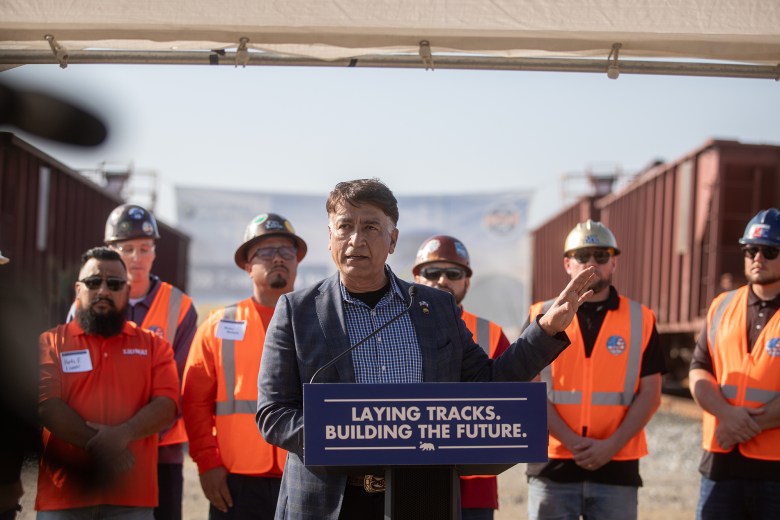
Ian Choudri is the chief executive officer of the California High-Speed Rail Authority, the state agency building America’s first true high-speed rail line, and on October 10, 2026 his own board voted 7-2 to strip him of the power he had held since taking the job: the sole authority to sign and manage contracts under $25 million. The vote came days after a state inspector general investigation found the authority had paid consultants nearly $600,000 in travel reimbursements that violated state policy or contract terms — first-class flights, luxury rideshares to nightclubs, a tiki bar and a cigar lounge — much of it approved without advance authorization, and in some cases at Choudri’s own request. Choudri, who was already a controversial figure after a February 2026 arrest on suspicion of misdemeanor domestic battery — an arrest prosecutors declined to prosecute for lack of a provable “dominant aggressor” — and a subsequent voluntary leave of absence, told his board he takes “full responsibility and accountability to fix if there was something broken in the system,” then declined to answer reporters’ questions in person as they followed him through the building after the vote. He remains CEO as of October 2026, with the Assembly’s Republican leader formally calling for his firing and no indication the board intends to remove him.
Background Information
Choudri was appointed CEO by the Authority’s board in August 2024, succeeding retiring CEO Brian Kelly, and was welcomed into the role by Governor Gavin Newsom: he arrived with more than 30 years of transportation-sector leadership, most recently as Senior Vice President at HNTB Corporation, an American infrastructure design firm with extensive federal and state transportation work. He inherited a project that has become a byword for cost and schedule overruns: voters approved a bond in 2008 for a San Francisco-to-Los Angeles line by 2020 at an estimated $33–45 billion, and the estimate now runs from $126.3 billion (the authority’s reassessed figure) to $231 billion by one outside estimate, with only about 119 miles under active construction and no full buildout expected before roughly 2039–2040. The inspector general had already warned in a July 2026 report that the agency could run out of cash by December 2027. In February 2026, Choudri, then 57, and his fiancée Lyudmyla Starostyuk, 46, were arrested at his Folsom home just after midnight on February 4 on suspicion of misdemeanor domestic battery, after a dispatch call the previous night reported a battery incident involving his teenage daughter; the fiancée was additionally booked on suspicion of “cruel or inhuman corporal punishment” of a child. The Sacramento County District Attorney’s Office declined to file charges against either adult on February 6, stating that officers “did not see or note any injuries to either individual” and that because the evidence “does not clearly demonstrate a ‘dominant aggressor’” there was “insufficient evidence to file charges” beyond a reasonable doubt; Choudri’s attorney, Allen Sawyer, said his client was “never asked to appear in court” and that the matter was over. Choudri took a voluntary leave of absence beginning February 17, and on March 4, 2026 the board announced after a closed-session review — conducted by the authority and the California State Transportation Agency — that he was cleared to return to work the next day. The review’s findings were not made public, and Republican lawmakers and at least one Democratic gubernatorial candidate had already called for his resignation.
The Controversy or Incident That Led to Their Cancellation
Board-imposed loss of authority after a watchdog audit; employment retained; no criminal charges in the parallel arrest. The inspector general found $594,000–$685,000 in unallowable or unauthorized consultant travel reimbursements, much of it approved without advance sign-off and some at top executives’ request; the board responded by stripping Choudri’s sole contracting authority, not his job. The February domestic-battery arrest ended without charges, and the personnel matters remain unadjudicated.
The inspector general’s report, released September 15, 2026, examined $1.15 million of the more than $2 million in travel reimbursements the authority paid to four consulting firms — KPMG LLP, Nossaman LLP, AECOM-Fluor Joint Venture and SYSTRA/TYPSA Joint Venture — between 2024 and 2026, and found nearly $600,000 of it violated state travel policies or the contracts: consultants flew first class, billed premium fares for a private-plane trip, and expensed rideshares to restaurants, bars, an escape room, a nightclub, a tiki bar, a cigar lounge and, per the account presented at the board meeting, Choudri’s own house. At least $685,000 — roughly 60 percent of what was reviewed — was paid out without travel being approved in advance, and in some cases agency staff learned of the trips only when the invoices arrived; one legal consultant collected $40,800 in travel reimbursements plus $86,500 in “travel time” for 30 Denver–Sacramento trips in a single year, flying Denver-to-California 20 times to “meet with the executive team” without explaining why the meetings could not be remote. When questioned about the need to attend in person, that consultant said Choudri himself had requested his presence, so he did not need to justify it — adding it would be inappropriate to question Choudri’s direction, “as other consultants in other Authority offices are learning the hard way.” The board’s answer came at a special meeting on October 9, 2026: a 7-2 vote canceling Choudri’s sole authority to sign and manage contracts under $25 million and requiring the agency’s in-house attorneys to approve or change any new or existing contract. Board Chair Steve Kawa, who called the special meeting, said “we are not just gonna sit back and ignore that we had this travel issue” and “not one dollar of California taxpayer dollars should be misused,” while board member Lynn Schenk — on the board since 2003 — declared “I am outraged that we would be treated like a piggy bank for these kinds of expenditures,” and board member Henry Perea said the state should consider terminating the four firms’ contracts outright, something Governor Newsom has also floated. Choudri told the board “we remain committed” and that the authority would “take full responsibility and accountability to fix if there was something broken in the system,” and said unspecified “disciplinary actions” were being taken against consultants — but when reporters pressed him for answers after the meeting about the expenses and about calls for his resignation, he walked away without responding, escaping into a separate room while a CBS camera rolled; the authority’s acting head of external affairs, Matt Rocco, stepped in, traded heated exchanges with journalists, and never explained why the CEO would not speak for himself.
Public Reaction and Consequences
The fallout has been bipartisan in direction if not in kind. Assembly Minority Leader Alexandra Macedo, a Visalia Republican, sent the board a letter the day before the vote calling for Choudri’s firing, accusing him of “a pattern of misuse of taxpayer dollars and abuse of public trust” and writing that “the routine approval of improper consultant expenses represents a severe breach of fiduciary responsibility” — and, per KCRA, that “Mr. Choudri’s brazen disregard for the law undermines the fundamental integrity of our state government.” The authority, for its part, has paused all travel payments to the four firms, begun reviewing their outstanding claims, and started retraining staff, executives and consultants on travel policy, per Chief Financial Officer Jamey Matalka, while the board expects the firms to repay the impermissible expenses; taxpayers directed more than $250 million total at the four firms between 2024 and 2026, of which the inspector general reviewed under $2 million. In an emailed statement to The California Post, Choudri defended the agency’s trajectory, saying it has taken “specific and focused efforts to reduce its consultant costs” with “upwards of $68 million of savings on consultant contracts” over two years, and that it is “reinforcing its travel approval and reimbursement processes to ensure every consultant trip is appropriate, justified and fully compliant with state policy.” The scandal has further energized the project’s longtime critics, who now pair the travel findings with the inspector general’s warning that the agency could run out of money by the end of 2027.
Current Status
As of October 10, 2026, Choudri remains CEO of the California High-Speed Rail Authority — stripped of unilateral contracting power but still in the job, with the board having treated the audit as an oversight problem to be managed rather than a resignation demand to be answered. Kawa told reporters the board is “taking seriously the issues this authority is dealing with” and signaled further scrutiny: “We dealt with travel today, one aspect of the consultants. We have to look at what else is happening with these contracts.” The travel reimbursements identified as unallowable are expected to be recovered from the firms, and the authority agreed to adopt or partially adopt the inspector general’s recommendations — including a travel-expectations memo — by early 2027, though the inspector general rebuked the authority’s insistence that it need not justify each consultant trip as “fundamentally incorrect.” The February 2026 arrest remains closed with no charges filed; the March internal review that cleared Choudri to return was never published. Whether the board will act on Macedo’s call to fire him — or on any future finding that touches Choudri directly — remains unannounced, and Choudri, through the authority, has given no public indication he intends to step down.
Impact on Their Career/Life
Choudri’s tenure has become a case study in how a signature infrastructure appointment can be hollowed out without ever being formally revoked: eighteen months after Newsom welcomed him as “the perfect steward for the next phase of high-speed rail,” his own board voted 7-2 to take away the unilateral contract-signing power that defined the CEO role, a Republican assembly leader is openly demanding his firing, and his instinct to stay silent when reporters cornered him after the vote — fleeing into a side room while his spokesman absorbed the questions — gave the spending scandal its defining image. He now leads a megaproject whose cost estimates run as high as $231 billion, whose completion has slipped past 2039, and whose own inspector general says may run out of money by the end of 2027 — with his personal authority reduced, his handling of the travel program under continuing board review, and no charges from the February arrest but a public record that now permanently pairs his name with first-class flights to nightclubs and cigar lounges billed to California taxpayers.
Sources
- New York Post, “High speed rail CEO dodges questions after stripped of contracting authority,” Oct. 10, 2026 — source
- CapRadio, “High-speed rail board limits CEO contract authority after $600,000 travel scandal,” Oct. 9, 2026 — source
- KCRA 3, “High-Speed Rail Board votes to limit project CEO’s spending power,” Oct. 9, 2026 — source
- CalMatters, “California high-speed rail consultants flew first-class, visited bars and a nightclub on taxpayers’ money,” Sep. 15, 2026 — source
- CBS News Sacramento, “California High-Speed Rail CEO arrested on suspicion of domestic battery; DA declines charges,” Feb. 17, 2026 — source
- E&E News by POLITICO, “California rail CEO cleared to return after February arrest,” Mar. 5, 2026 — source
- Office of Governor Gavin Newsom, “Governor Newsom welcomes new CEO of California High-Speed Rail,” Aug. 8, 2024 — source
- @nypost on X, trigger post, Oct. 10, 2026 — source