Abdulrahman Alfozan
Introduction
Abdulrahman Alfozan is a 35-year-old Saudi national who was arrested on October 9, 2026, and charged on October 13 in federal court in San Francisco with using or endeavoring to use a device to intercept oral communications — the government’s case being that he concealed an encrypted covert audio recorder in an executive conference room at his employer, OpenAI. OpenAI fired him. He has not entered a plea, is in federal custody, and faces up to five years in prison and a $250,000 fine if convicted. His lawyer, William Pernik, says he is charged with violating a federal recording statute, “not stealing trade secrets or working as a foreign agent,” and has asked the public to withhold judgment; the New York Post reported he was arrested just three days before a one-way flight to Saudi Arabia he had booked was set to take off.
Background Information
According to the federal complaint, Alfozan had been employed as an engineer at OpenAI since July 2025. His LinkedIn profile, which the Hindustan Times noted was in focus after the arrest, lists OpenAI as his current employer, University of California, Berkeley, as his education, and a San Francisco Bay Area location; per the same profile — which the Hindustan Times reported it could not independently verify — his previous workplaces included Meta and Microsoft. He appears in the UC Berkeley School of Information alumni directory as a 2025 MIDS (Master of Information and Data Science) alumnus, with a bio describing him as an “Experienced Engineering Lead with 9 years of building scalable and reliable software systems in the data and AI/ML domains.” Publications on his LinkedIn include “Gradio: Hassle-Free Sharing and Testing of ML Models in the Wild,” and his GitHub profile, @alfozan, likewise lists OpenAI and San Francisco. The New York Post, citing an Arabic podcast interview from last month, reported that Alfozan studied computer science and engineering at MIT, said in the interview that he had helped advise Saudi government agencies on technology, and described meeting Crown Prince Mohammed bin Salman during the prince’s 2016 Silicon Valley visit — “You learn from the source and then, God willing, bring that experience and knowledge back to the homeland,” he said in the interview. The Post also reported he had previously worked at Meta and an Andreessen Horowitz-backed startup and was listed as a venture partner at Riyadh’s RAED Ventures alongside Prince Khalid bin Bader Al Saud, a member of the Saudi royal family; the MIT claim sits alongside the Berkeley and LinkedIn listings above and has not been reconciled with them.
The Controversy or Incident That Led to Their Cancellation
Charged, not convicted. Alfozan was arrested on October 9, 2026, and charged on October 13 in the U.S. District Court for the Northern District of California with using or endeavoring to use an electronic, mechanical, or other device to intercept oral communications. The allegations are unadjudicated: no plea has been entered, and while his attorney, William Pernik, has asked for judgment to be withheld until the full facts are known, he is presumed innocent unless and until convicted.
According to the complaint, on or about September 28, 2026, Alfozan installed an audio recording device in an executive conference room inside one of OpenAI’s San Francisco buildings — concealed in toilet paper and inserted into a USB port on the back of a television. OpenAI personnel discovered the device, which the company called a “sophisticated recording device,” on September 30, and its contents were encrypted. The room was frequently used for meetings covering highly confidential technical, commercial, and strategic information, including proprietary research, product plans, and government engagements.
According to the complaint, Alfozan had no authority to access the room or take part in meetings there, yet footage showed him appearing near the conference room on multiple occasions; before the device was installed, he used a productivity tool to make multiple inquiries about OpenAI’s building addresses, meeting rooms, meeting-room capacities and calendars, and the locations of “leadership and exec” and external partner meetings. Federal prosecutors also allege he used chatbots to plot the recording effort, asking about meeting-room capacities and calendars.
The complaint further alleges that a chatbot account associated with Alfozan’s spouse — which, prosecutors said, “shared multiple identifiers and attributes” with Alfozan’s own chatbot account — submitted prompts between September 24 and September 30 relating to building, customizing, installing, audio recording, testing, obfuscating, and remote accessing a device, including “build[ing] a continuous audio recorder,” “customiz[ing] Wi-Fi . . . connectivity,” “improv[ing] audio and live listening,” and “encrypt[ing] the SD card.” Between September 27 and 28, the same account submitted prompts specifically related to the device later found in the room, including its custom header and unique MAC address.
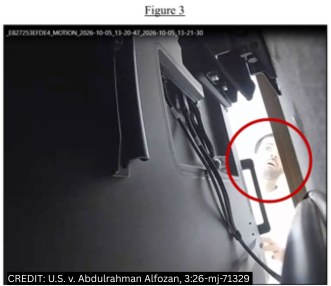
On October 5, the complaint says, Alfozan entered the conference room and appeared to look behind the television where the device was inserted; the company had since added a camera to the room, which, according to the FBI, captured him entering and checking behind the television. Also on October 5, he left a bag unattended in a different room in the building; OpenAI security personnel opened it and found his wallet, identification, and a second similar recording device. Per the New York Post, the FBI arrested Alfozan only three days before the one-way flight to Saudi Arabia he had booked was set to take off, and OpenAI fired him earlier that week.
The FBI and the Justice Department announced the arrest on October 13, the day of Alfozan’s initial federal court appearance. The case is being prosecuted by Assistant U.S. Attorney Nicolas Parker for the Northern District of California, with assistance from Trial Attorney Kate Tagert of the National Security Division’s Counterintelligence and Export Control Section; the DOJ says the prosecution is in support of National Security Presidential Memorandum 11, designed to support American superiority in super intelligence technology.
Public Reaction and Consequences
The announcement drew heavy tech and national-security coverage on October 13, and the DOJ’s National Security Division account announced the arrest on X with photos of the recording device and a surveillance image of Alfozan. OpenAI said that after discovering the device, it “used our models to understand the device and where it had come from, identifying that a specific employee had planted it a few days earlier,” and referred the matter to the FBI; the company added that “at this time, we have no indications of this individual inappropriately accessing or exfiltrating model weights, source code, or customer data,” and that “the employee was terminated.” The Hindustan Times reported that Alfozan’s LinkedIn profile was in focus after the arrest.
Government officials framed the case in national-security terms. Director of National Intelligence Jay Clayton said the matter “underscores why winning the global super intelligence race is a national security prerogative.” FBI Director Kash Patel said protecting American super-intelligence innovation is “one of our highest counterintelligence priorities.” U.S. Attorney Craig H. Missakian said, “For us it is a matter of national security.”
The consequences so far: termination from OpenAI, federal custody, and a detention hearing slated for October 19, per the Hindustan Times. Alfozan’s attorney, William Pernik, responded that his client was charged with violating a federal recording statute, “not stealing trade secrets or working as a foreign agent,” and asked “everyone to withhold judgment until full facts become known” — adding that Alfozan “came to this country years ago as a young person with a dream” and spent years contributing to an American tech sector “built in large part by immigrants like him.” U.S. Attorney Craig Missakian said the arrest “highlights our relentless efforts in partnership with the FBI to identify and prosecute those who seek to steal our technology. For us, it is a matter of national security.”
Current Status
As of October 15, 2026, Alfozan is in federal custody following his initial appearance in the Northern District of California. No plea has been entered; he is represented by attorney William Pernik, who says the charge alleges a recording-statute violation rather than trade-secret theft or foreign-agency work. The New York Post reported the FBI arrested him three days before his booked one-way flight to Saudi Arabia was to depart. The Hindustan Times reports a detention hearing is slated for October 19. If convicted, he faces up to five years in prison and a $250,000 fine, followed by three years of supervised release. The FBI’s investigation is ongoing, per OpenAI and Patel, and OpenAI says it has no indications of inappropriate access to or exfiltration of model weights, source code, or customer data. The charges remain accusations, and he is presumed innocent unless and until proven guilty.
Impact on Their Career/Life
OpenAI terminated Alfozan, ending the engineering job he had started there in July 2025. He remains in federal custody while the case proceeds, and the government is prosecuting it under NSPM-11 as a counterintelligence matter — a framing that treats the alleged recordings as a threat to American superiority in super intelligence technology. A conviction could carry up to five years of imprisonment.
Sources
- U.S. Department of Justice, “Saudi National Arrested for Installing Surreptitious Audio Recording Device at OpenAI,” October 13, 2026. source
- New York Post, “OpenAI engineer arrested by FBI for allegedly bugging office had booked one-way flight to Saudi Arabia,” Oct. 15, 2026 — source
- National Security Division (@DOJNatSec), X post announcing the arrest, October 13, 2026. source
- BBC News (Max Matza), “Saudi man charged with planting ‘sophisticated’ recording device in OpenAI office,” October 13, 2026. source
- CBS News (Sarah N. Lynch), “FBI arrests OpenAI employee for allegedly planting recording device in company offices,” October 13, 2026. source
- CNBC (CJ Haddad), “FBI arrests Saudi OpenAI employee who allegedly planted recording device in conference room,” October 13, 2026. source
- BleepingComputer (Lawrence Abrams), “OpenAI engineer arrested for allegedly planting spy device in office,” October 13, 2026. source
- Fox Business (Sophia Compton, Louis Casiano), “Saudi national accused of planting recording device in OpenAI executive conference room,” October 13, 2026. source
- The San Francisco Standard (George Kelly, Michael McLaughlin), “OpenAI engineer arrested in bugging of executive conference room,” October 13, 2026. source
- Hindustan Times (Shuvrajit Das Biswas), “Saudi OpenAI engineer arrested over hidden recording device; FBI director Kash Patel issues statement,” October 13, 2026. source
- LinkedIn, “Abdulrahman Alfozan” profile. source
- UC Berkeley School of Information, “Abdulrahman Alfozan” (alumni profile). source
- GitHub, “alfozan (Abdulrahman Alfozan)” profile. source